Shopify Plus CRO Agency Checklist for Scaling Brands
Use this Shopify Plus CRO agency checklist to evaluate analytics, testing, implementation, reporting, and conversion maturity before hiring.
Read articleLearn what a Shopify CRO agency should do, when to hire one, what deliverables to expect, and which hiring red flags to avoid before signing.
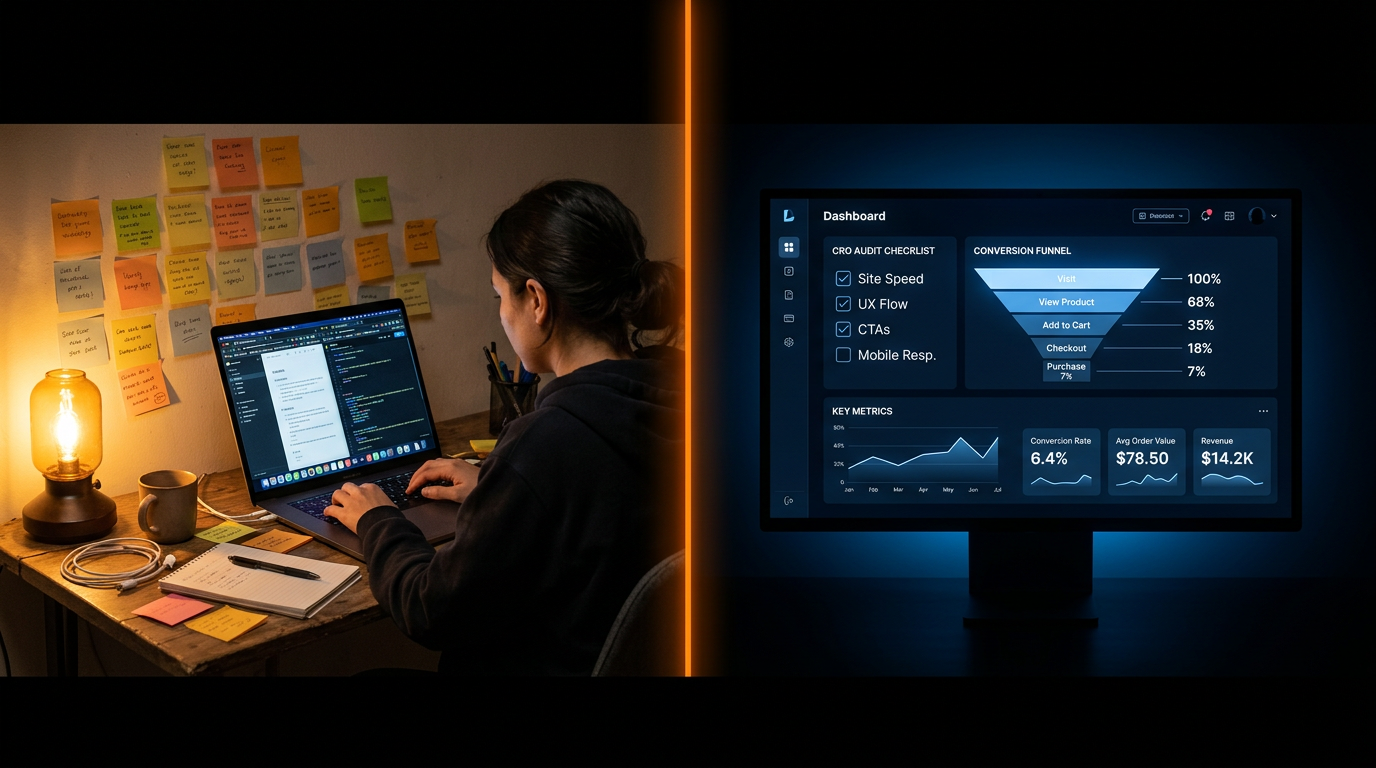
A Shopify CRO agency helps you turn more existing traffic into revenue by finding conversion leaks, prioritizing fixes, implementing changes, and measuring whether those changes improve buying behavior. The right agency should not only give you opinions. It should connect analytics, UX, offer clarity, Shopify development, and testing into one practical growth system.
If your store is already getting traffic but revenue is not scaling with ad spend, CRO is usually a better next step than launching more campaigns. More traffic only helps if the store can convert it profitably.
At GrowWithCRO, our work is built around one simple question: where is the store leaking money, and what is the highest-impact fix we can ship first?
A Shopify CRO agency improves the percentage of visitors who take valuable actions on your store. That usually means more product-page engagement, more add-to-carts, more checkout starts, more completed purchases, higher AOV, or stronger repeat-purchase behavior.
A good agency should work across five layers:
The important part is that CRO is not just design. A prettier product page can still fail if the offer is unclear, the price objection is unresolved, shipping details are buried, the page is slow, or the customer does not trust the brand.
You should consider hiring a Shopify CRO agency when the store has enough traffic or revenue for small conversion improvements to matter.
Common signs:
CRO makes the most sense when traffic is no longer the only bottleneck. If 10,000 visitors hit your store each month and the conversion rate improves from 2.0 percent to 2.4 percent, that is 40 more orders before adding a single new visitor. The exact value depends on your AOV and margin, but the logic is simple: fixing leaks makes every channel work harder.
Not every Shopify store needs a CRO retainer yet.
It may be too early if:
That does not mean you should ignore conversion. It means you may need a focused audit, analytics cleanup, product page improvements, page speed work, or offer cleanup before a full CRO program.
For lower-traffic stores, the best CRO work is usually not classic A/B testing. It is expert review, analytics-informed prioritization, UX fixes, and measured rollouts. You can still improve the store. You just should not pretend every change has enough data for statistical certainty.
A lot of stores confuse these roles. They overlap, but they are not the same thing.
| Partner type | Primary job | Best used for | Risk if used alone |
|---|---|---|---|
| Shopify CRO agency | Find and fix revenue leaks | Improving conversion rate, AOV, checkout flow, product-page clarity | Can be slow if it cannot implement fixes |
| Shopify developer | Build theme, app, and storefront changes | Custom sections, landing pages, speed fixes, integrations | May build requested tasks without challenging strategy |
| Paid media agency | Bring qualified traffic | Meta, Google, TikTok, creative testing, campaign scaling | More traffic can amplify store leaks |
| Brand/design agency | Improve identity and presentation | Visual system, messaging, brand polish | May prioritize aesthetics over measurable funnel outcomes |
The strongest setup is when CRO strategy and Shopify implementation are connected. A CRO agency that cannot ship changes becomes a reporting partner. A developer without CRO judgment becomes a task-taker. A paid media team sending traffic into a leaky store gets blamed for problems the store created.
GrowWithCRO sits in the middle: CRO strategy, Shopify development, and page speed optimization all need to support the same buying path.
A real Shopify CRO engagement should give you more than a list of opinions.
You should expect some mix of these deliverables:
This is the diagnostic layer. The agency reviews analytics, key templates, customer journey, product pages, collection pages, checkout behavior, site speed, trust signals, and offer clarity.
A useful audit should not say "improve the product page." It should say what is broken, where it appears, why it matters, and what to change first.
A CRO roadmap should rank ideas by expected impact, effort, confidence, and dependency.
For example, adding shipping clarity above the add-to-cart button may be a high-confidence fix. Rebuilding the entire PDP may be high effort and should only happen if the research supports it.
For bigger changes, you should see the structure before development starts. This can include PDP sections, landing page blocks, comparison tables, FAQ modules, guarantee blocks, review placement, subscription messaging, or bundle framing.
The agency should either implement changes directly or work closely with your developer. CRO ideas that sit in a slide deck do not improve conversion rate.
Every change should be checked on mobile, desktop, major browsers, product variants, cart drawer, discount logic, tracking, and checkout flow. A conversion improvement that breaks a variant selector is not an improvement.
The report should explain what changed, what metric moved, what did not move, and what the next decision is. Good CRO reporting is decision-focused, not screenshot-heavy.
The first 90 days should not be random testing. It should build momentum from diagnosis to implementation.
The agency should review analytics, Shopify data, ad landing pages, top products, conversion rate by device, add-to-cart rate, checkout rate, AOV, page speed, and current tracking quality.
If the data is messy, this phase should include analytics cleanup. Bad tracking creates false confidence.
The agency should identify the biggest leaks and decide what to fix first. For many Shopify stores, early priorities are product page clarity, shipping and returns trust, reviews, offer framing, cart drawer friction, bundle presentation, mobile speed, and checkout expectation-setting.
This is where the agency proves it can execute. You should see real changes shipped into Shopify, not only recommendations. Some changes may be tested. Others may be rolled out directly if the issue is obvious and testing volume is too low.
The agency should review funnel metrics, compare before and after behavior, document what worked, and build the next round of improvements.
The goal is a repeatable system: find leak, prioritize fix, ship safely, measure, repeat.
Use this checklist before signing.
The best agencies will not pretend every brand is ready for the same CRO package. They will diagnose the stage of the store first.
Be careful if an agency:
A CRO agency should increase clarity, not complexity. If every recommendation adds another app, popup, or discount, your store may convert worse in the long run.
When we review a Shopify store, we start with the revenue path.
That usually means:
We also look for proof opportunities. For example, recent Shopify analytics screenshots from client work showed stronger conversion movement in two stores: one with sessions converted up 38 percent and another with checkout or sessions converted up 48 percent. The point is not to copy the same changes across stores. The point is to build the same discipline: diagnose the leak, ship the fix, measure the result.
If you are not ready for a full CRO program, we may recommend starting with a focused audit, page speed cleanup, or better measurement using a dashboard like the Shopify Looker Studio template.
Before you speak with any Shopify CRO agency, gather these:
If you cannot answer these yet, that is fine. A good agency can help you build the baseline. But the more context you bring, the faster the work becomes practical.
A Shopify CRO agency specializes in improving the conversion performance of Shopify stores. It reviews analytics, customer behavior, product pages, checkout flow, trust signals, speed, and offer clarity, then recommends and implements changes that help more visitors buy.
No. A/B testing is one CRO method, but it is not always the right first step. Low-traffic stores often need audit-led fixes, UX improvements, analytics cleanup, and better product-page messaging before formal testing makes sense.
You need enough traffic to see stable patterns. For formal A/B testing, you need enough conversions for a meaningful read. For expert CRO audits and implementation, you can start earlier, but the work should be framed as prioritized improvements rather than statistically proven tests.
Hire a Shopify developer when you know exactly what needs to be built. Hire a CRO agency when you need help deciding what to fix, why it matters, and how to measure it. Ideally, your CRO partner should also understand Shopify development or work directly with your developer.
It should report on the metrics tied to the work: conversion rate, add-to-cart rate, checkout-start rate, purchase rate, AOV, revenue per session, device performance, and page-level behavior. The report should explain decisions, not just show charts.
If you are a Shopify or DTC brand with traffic, a clear offer, and a need to turn more visitors into buyers, start with a CRO strategy call. We will review the store, identify the biggest visible leaks, and tell you whether CRO, page speed, Shopify development, or measurement cleanup should come first.
If your store has traffic but revenue is not scaling the way it should, book a strategy call with GrowWithCRO. We will help you understand where the funnel is leaking, what to fix first, and whether a full CRO program makes sense.
Use this Shopify Plus CRO agency checklist to evaluate analytics, testing, implementation, reporting, and conversion maturity before hiring.
Read articleSupplement stores have a different CRO problem than other DTC brands. Here's the six-layer trust framework that lifts conversion for health and vitamin brands.
Read articleMost Shopify A/B tests produce unreliable results. Here's the correct framework: traffic minimums, test duration, what to test first, and which tools to use.
Read article